


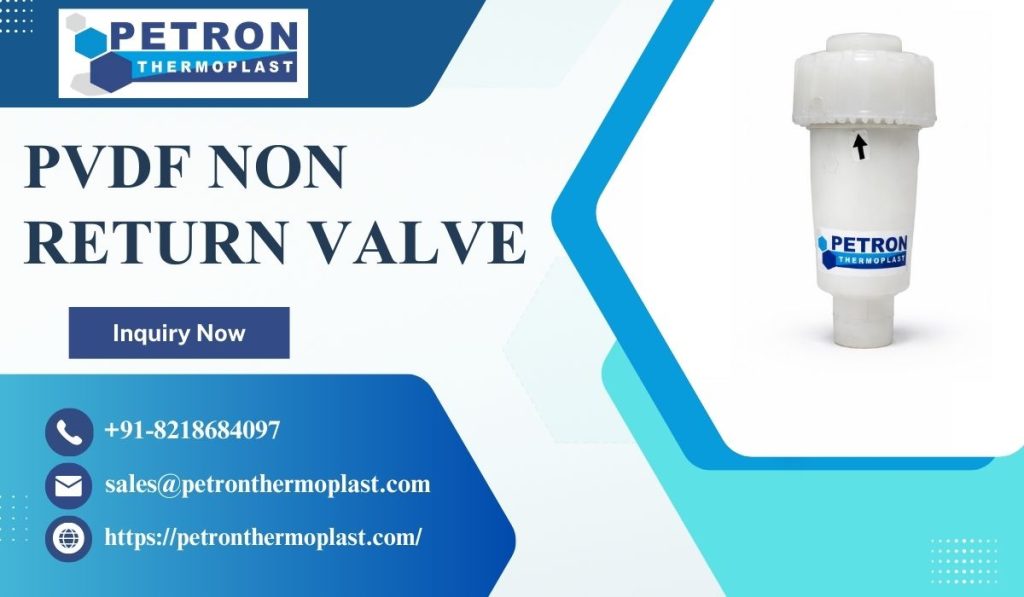
In modern chemical processing industries, maintaining safe, controlled, and uninterrupted fluid flow is essential for operational efficiency and plant safety. One of the most critical components in any chemical pipeline system is the PVDF Non Return Valve, also known as a check valve. Among various materials available, PVDF (Polyvinylidene Fluoride) Non Return Valves have emerged as the preferred choice for chemical processing units due to their superior chemical resistance, thermal stability, and long service life.
This article explores why Non Return Valves (NRV) is the best solution for chemical processing plants and how Petron Thermoplast delivers high-quality industrial-grade PVDF NRVs for demanding applications.
Understanding the Role of Non Return Valves in Chemical Plants
A Non Return Valve is designed to allow fluid to flow in only one direction while preventing reverse flow. In chemical processing units, uncontrolled backflow can lead to:
- Contamination of raw materials
- Equipment damage
- Pressure imbalance
- System leakage
- Safety hazards
PVDF Non Return Valves act as protective barriers, ensuring that aggressive chemicals, solvents, and process fluids move safely through pipelines without backflow risks.
What is PVDF and Why is it Ideal for Chemical Applications?
PVDF (Polyvinylidene Fluoride) is a high-performance fluoropolymer widely used in chemical and industrial systems. It offers a unique combination of mechanical strength and chemical stability.
Key Properties of PVDF:
- Excellent resistance to acids, alkalis, and solvents
- High temperature tolerance (up to 140°C)
- UV and weather resistance
- Low permeability
- Non-reactive surface
- High purity and low contamination risk
These properties make PVDF an ideal material for Non Return Valves used in chemical processing environments.
Advantages of Using PVDF Non Return Valves in Chemical Processing Units
- Superior Chemical Resistance
PVDF Non Return Valves can withstand exposure to highly corrosive chemicals such as sulfuric acid, hydrochloric acid, chlorine, and organic solvents. This ensures long-term performance without material degradation.
- High Temperature and Pressure Stability
Chemical processes often operate under extreme conditions. PVDF NRVs maintain structural integrity under high temperatures and pressures, preventing deformation and leakage.
- Excellent Mechanical Strength
Unlike standard plastic valves, PVDF valves offer higher tensile strength and impact resistance. This makes them suitable for heavy-duty industrial pipelines.
- Leak-Proof Performance
Precision-engineered seals and tight tolerances ensure that PVDF Non Return Valves prevent backflow and leakage, even in continuous operation.
- Long Service Life
PVDF valves resist scaling, corrosion, and wear, resulting in minimal maintenance and extended operational life.
- High Purity and Clean Flow
PVDF is widely used in pharmaceutical and semiconductor industries due to its non-contaminating properties, making it ideal for sensitive chemical processes.
Types of PVDF Non Return Valves for Chemical Plants
Different chemical systems require different valve configurations. Common types include:
Swing Check Valves
These use a hinged disc that opens with flow and closes during backflow. Suitable for low-pressure and large-diameter pipelines.
Spring Loaded Check Valves
Designed for quick response and compact installations. Ideal for high-pressure systems.
Ball Check Valves
Use a spherical ball for sealing. Suitable for slurry and viscous fluids.
Wafer Type Check Valves
Compact design for limited installation space.
Petron Thermoplast offers customized PVDF NRVs to meet specific project requirements.
Key Applications in Chemical Processing Units
PVDF Non Return Valves are widely used in:
- Acid handling systems
- Alkali transfer pipelines
- Solvent distribution units
- Chlorination plants
- Effluent treatment plants
- Fertilizer manufacturing
- Petrochemical processing
- Pharmaceutical production
These valves ensure process stability and equipment protection in critical operations.
How to Choose the Best PVDF Non Return Valve?
Selecting the right valve requires careful consideration of several factors:
- Chemical Compatibility
Ensure the valve material is compatible with the media being handled.
- Operating Temperature & Pressure
Match valve specifications with system conditions.
- Flow Rate and Pipe Size
Proper sizing avoids pressure drops and turbulence.
- Installation Type
Consider flange, threaded, or socket connections.
- Maintenance Requirements
Choose designs that allow easy inspection and replacement.
- Certification & Standards
Look for ISO, ASTM, or industry compliance.
Why Petron Thermoplast is a Trusted Supplier of PVDF Non Return Valves?
With decades of experience in industrial thermoplast manufacturing, Petron Thermoplast is a leading supplier of high-performance piping solutions in India and international markets.
Key Strengths:
- Advanced CNC machining and fabrication
- Premium-grade PVDF raw materials
- Strict quality control procedures
- Customized manufacturing solutions
- Competitive pricing
- Timely delivery schedules
- Strong after-sales support
Petron Thermoplast delivers valves that meet global industrial standards for chemical processing applications.
Manufacturing & Quality Assurance Process
At Petron Thermoplast, every PVDF Non Return Valve undergoes comprehensive testing to ensure reliability and performance.
Quality Checks Include:
- Dimensional accuracy testing
- Pressure testing
- Leak testing
- Chemical resistance testing
- Visual inspection
- Material certification
These quality processes guarantee defect-free products for critical industrial use.
Installation and Maintenance Best Practices
Installation Tips:
- Install valves in correct flow direction
- Ensure proper pipe alignment
- Avoid over-tightening
- Use recommended gaskets
- Maintain adequate support
Maintenance Guidelines:
- Periodic inspection
- Seal replacement when required
- Cleaning of internal components
- Performance monitoring
Following proper maintenance practices helps extend valve life.
Cost Benefits of PVDF Non Return Valves
Although PVDF valves have a higher initial cost compared to conventional plastic valves, they provide significant long-term savings.
Economic Advantages:
- Reduced replacement frequency
- Lower downtime
- Minimal repair costs
- Improved system efficiency
- Enhanced safety compliance
This makes PVDF NRVs a smart investment for chemical plants.
Environmental and Safety Considerations
PVDF is an environmentally stable material that does not release harmful substances. Its durability reduces waste generation and supports sustainable industrial practices.
Additionally, PVDF Non Return Valves improve workplace safety by preventing chemical leakage and system failures.
Future Trends in Chemical Valve Technology
With Industry 4.0 and automation adoption, PVDF valves are being integrated into smart pipeline systems. Future developments include:
- Sensor-enabled valves
- Predictive maintenance systems
- Enhanced sealing technologies
- Lightweight composite designs
Petron Thermoplast continuously invests in innovation to meet evolving industrial demands.
Conclusion
Choosing the best PVDF Non Return Valve for chemical processing units is crucial for ensuring operational safety, efficiency, and reliability. With superior chemical resistance, thermal stability, and mechanical strength, PVDF NRVs outperform conventional materials in harsh industrial environments.
Petron Thermoplast offers premium-quality PVDF Non Return Valves designed for demanding chemical applications. Backed by advanced manufacturing, strict quality control, and customer-centric service, Petron Thermoplast remains a trusted partner for industrial piping solutions. For customized PVDF Non Return Valves and expert consultation, connect with Petron Thermoplast today and upgrade your chemical processing systems with confidence.