
Best Tips to Write Top-Quality CIPD Assignment for Beginners
Hello HR enthusiasts. Are you dipping into CIPD qualifications? If yes, then let me tell you that you will be assigned to write tons of assignments.
I have written tons of CIPD assignments and have faced blank page syndrome. And yes, that blank assignment page can feel like a mountain.
I remember my first ever CIPD level 3 assignment on employment law. I was sitting with a cup of cold coffee, figuring out where to start.
But trust me, with the help of straightforward tips, you can flip overwhelm into confidence and achieve excellent grades.
So say goodbye to stress because today I will share some top tips for writing the best CIPD assignment. So let us get started.
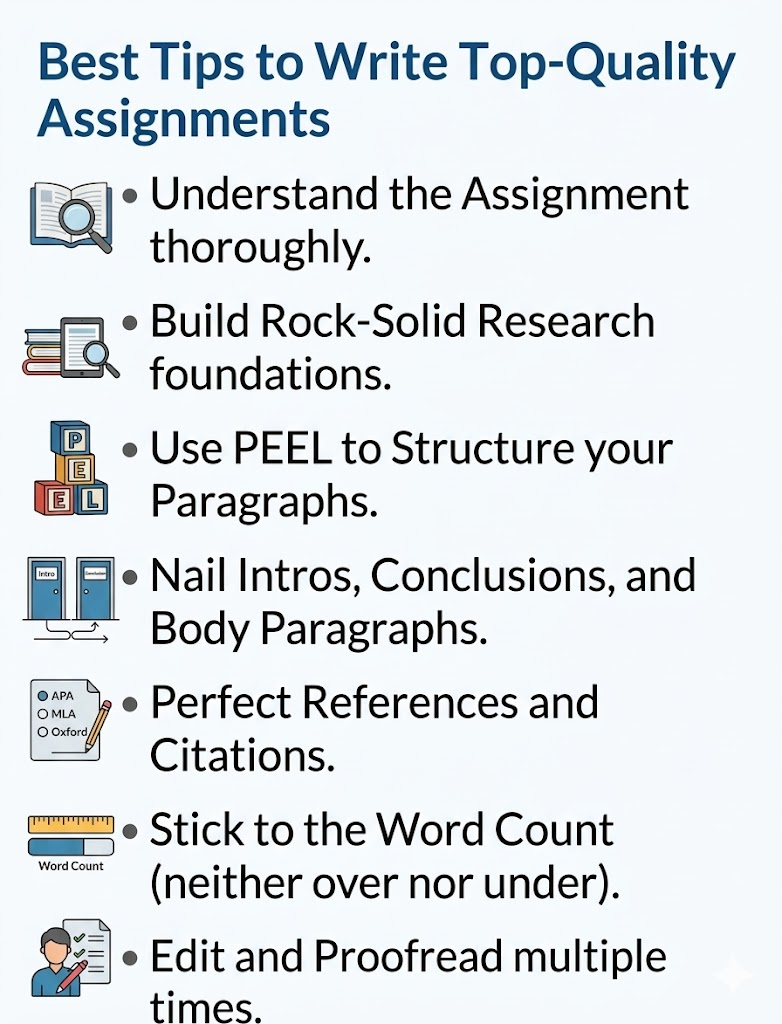
1. Understand the Assignment Brief Properly
First things first. You need to understand the assignment brief properly. You won’t believe it, but when I was working on my assignment, I reviewed the guidelines and started writing (overconfidence, lol). I kept on writing irrelevant sections for days that took me nowhere.
So what do you have to do? Grab your highlighter and sit with the guidelines for your CIPD level 3, 5, or 7 assignment guidelines. Look for the learning outcomes, word count limit, deadline, and other necessary guidelines.
2. Build Rock Solid Research Foundations
Do you know? Good research powers everything. Yet beginners chase endless links.
I remember I’d spend weeks on research, wondering that oh this source also looks important. First off, you do not need to read every relevant source about your topic. If you do this, stop right away,
Here’s the tip: only access the trusted CIPD resources like: factsheets, reports, surveys, People Management Magazine, and others.
You can also search for relevant books and industry reports for case studies. Also, make sure to use HR theories that are relevant to your topic. Timebox it to two hours per topic max to stay sharp.
3. Use PEEL to Structure Every Paragraph
Here’s a small secret for beginners: CIPD assessors crave logic. And the PEEL (Point, Evidence, Explain, Link) framework nails it perfectly.
How to use it? It is simple.
- P – Point: start your paragraph with a clear topic sentence that directly addresses the specific part of the assignment brief.
- E – Evidence: Next, support your point with relevant and credible evidence. This means citing CIPD resources or HR models.
- E – Explain: now you have to analyse the evidence to show your understanding of the point you made. Show how and why the evidence supports your point.
- L – Link: tie the paragraph back to the overall assignment question. This makes sure that your point is cohesive and focused.
4. Nail Intros, Conclusion, and Flows
Just like any other assignment, the intro plays a significant role in hooking readers. So you cannot compromise on it.
So always begin with a sentence that tells about the topic. Then briefly explain why this topic matters to organisational success.
A key tip is to define any key terms or ambiguous concepts early so the assessor can understand your interpretation.
If you are facing the blank page syndrome for writing your intro, then it is best to get Assignment Help Malaysia from experts and score high.
5. Perfect References and Appendices
Messy references in CIPD assignments are a major red flag. The CIPD aassignment guidelines tell students to use some supporting evidence in the content.
So while you are researching and gathering material according to the topic, make sure to make a list of sources. This list of sources will be added at the end of your assignment.
Pro tip:
You must use 3-5 references in support of each of your reports. Also, when you’d read the guidelines carefully, you will see that this is also included in there.
6. Stick to the Word Count
You might be wondering why I am constantly emphasising reading the guidelines. Well, because half of your work will be sorted after reading them.
Whether you are enrolled in the CIPD level 3, 5, or 7, there are different word count requirements for each level’s assignment.
- Foundation Level 3 assignment: approximately 3,000 words (+/- 10%)
- Associate Level 5 assignment: approximately 5,000 words (+/- 10%)
- Advanced Level 7 assignment: approximately 7,000 words (+/- 10%)
I know for wider topics, it is often hard to cover everything within this word limit. But shift your focus from word count to what is imperative for the report.
And again, go through the guidelines and see what is asked of you. Then first cover those LOs and then add other content if there is some word limit left.
7. Edit and Proofread
Editing and proofreading are as important as writing the CIPD assignment. Do you think that neglecting this step will save you time? Well it might, but you will lose credibility if there are grammatical or structural mistakes in your content.
This is when editing anf proofreading save you. Begin with editing. At this step, you must ensure that your assignment directly answers the given prompt. Then check if the argument flows logically, and each paragraph must begin with a clear topic sentence.
For proofreading, read aloud the content to catch awkward phrasing. Also, make sure to look for specific errors (one error at a time) for a focused outcome.
Check citations, formatting, aand you are all done to submit!
You’re Set to Succeed
These tips transformed my rookie struggles into merit distinctions. CIPD builds real HR muscle. Start decoding that brief today, build smartly, structure ruthlessly, edit fiercely. You’ve got the tools now, go claim that qualification.
Final Words
And this brings us to the end of this guide. Writing CIPD assignments is hard. But not too overwhelming if you know the right steps and tips.
So make sure to re-read this guide from the beginning and understand all the steps. From understanding the assignment brief to editing and proofreading, each step is important.
You can also connect with an expert if you are struggling with your CIPD assignment. They will help you fix the content and achieve excellent grades!