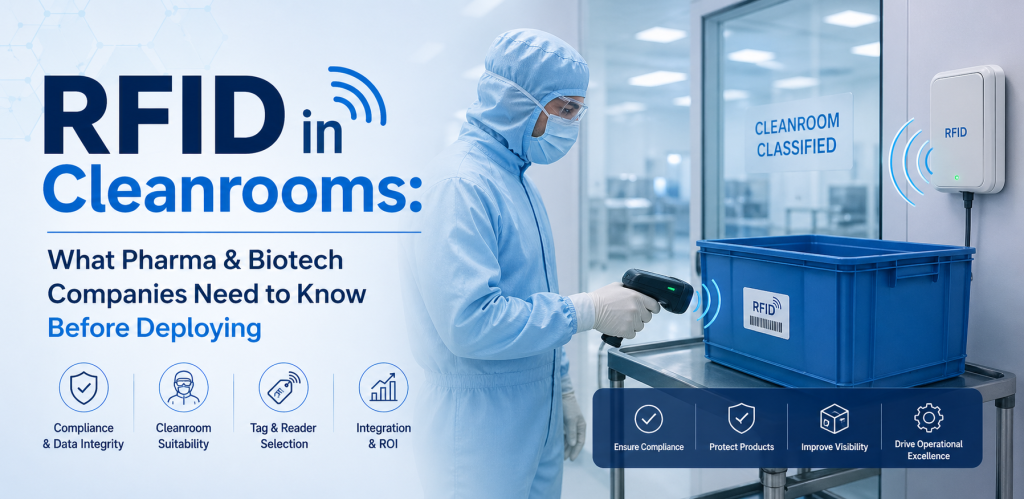
Cleanroom RFID projects fail more often at the tag selection stage than anywhere else. That sounds like a narrow problem, but it cascades quickly. Wrong tag material in an autoclave environment, and you are replacing tags within weeks. Wrong adhesive chemistry under repeated IPA wipe-downs, and labels start lifting — introducing both a contamination risk and a read reliability problem at the same time.
Before getting into deployment architecture, the physical constraints of cleanroom environments are worth working through in some detail. They are different enough from standard industrial settings that experience with RFID in warehouses or offices do not directly apply.
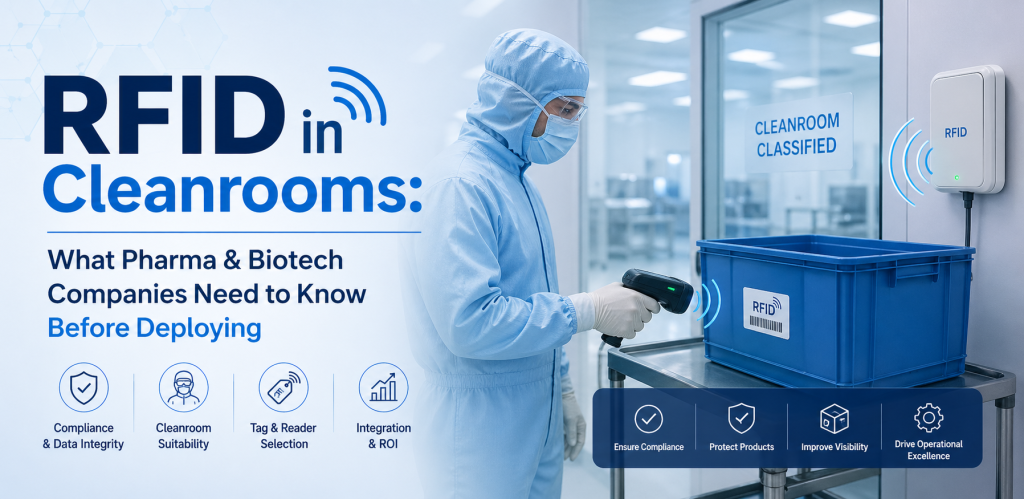
What Makes Cleanrooms Different for RFID
The obvious answer is particle counts. ISO-classified cleanrooms maintain strict limits on airborne particulates, and anything introduced into the space — people, equipment, consumables, tools — has to meet the cleanliness requirements for that classification. RFID tags are no exception.
But particle count compliance is just the starting point. The more operationally challenging requirements come from the cleaning protocols. Cleanrooms in pharmaceutical and biotech settings get wiped down regularly with disinfectants that are genuinely aggressive — 70% isopropyl alcohol is common, and many facilities also use hydrogen peroxide vapor, peracetic acid solutions, or sporicides depending on the product being manufactured. These chemicals attack adhesives, inks, and substrate materials that work fine under normal conditions.
Add autoclave sterilization for equipment that gets cycled out of the cleanroom, and you are asking your tags to survive conditions that standard RFID hardware was never designed for. A tag that handled 50 autoclave cycles at 134 degrees Celsius without delaminating is a very different product than a general-purpose warehouse tag.
Tag Selection: The Questions You Need Answered Before You Buy
The first question is whether the tag will be autoclaved. If yes, you need a tag specifically rated for repeated steam sterilization at the temperatures your facility uses. Some manufacturers provide cycle-count ratings; ask for test data, not just a marketing claim. If the tag is staying in the cleanroom and will only be wiped down, that simplifies things, but you still need to confirm compatibility with the specific disinfectants in your cleaning SOPs.
The second question is the surface it will adhere to. Most cleanroom equipment is stainless steel, which has two implications for RFID. Metal detuning affects antenna performance with standard tags, so you need on-metal tags with a foam or hard spacer layer that prevents the antenna from coupling to the metal surface. And stainless steel surfaces are wiped frequently under pressure, so the adhesive needs to hold through repeated mechanical and chemical exposure.
Third, physical profile. Any protrusion from the equipment surface creates a potential particle trap and a snag point during cleaning. Low-profile, flush-mount tags are strongly preferred in most cleanroom applications. The slightly higher cost compared to standard tags is easily justified by the reduction in contamination risk.
Fixed Readers vs. Handheld: What Most Deployments Get Wrong
The typical path for a cleanroom RFID project starts with handhelds. They are cheaper to start with, simpler to deploy, and let you prove value before committing to permanent infrastructure. That is a reasonable approach, but it has a ceiling.
Handheld reads depend on someone actively sweeping a space with a reader. For periodic inventory counts, that works well. For capturing real-time movement — knowing when a centrifuge left Zone A and entered Zone B, or when a tool was removed from a workbench at 2 AM — handhelds cannot tell you what you need to know.
Fixed readers at zone transitions are what make continuous monitoring possible. In a cleanroom context, the most valuable fixed reader locations are typically the airlock or gowning room transition, the entry and exit points of each production zone, and the metrology or calibration room. Readers at these points capture every asset movement without requiring any operator action.
One thing to spec carefully: reader hardware for cleanroom environments needs to meet the same cleanliness standards as everything else in the space. There are reader enclosures designed for cleanroom installation; standard industrial readers are not appropriate. The cables and connectors also need to be compatible with your cleaning protocols.
Work-in-Process Tracking Is Usually the Bigger Win
Most discussions of cleanroom RFID focus on equipment tracking and calibration management, and both matter. But WIP tracking is often where the larger operational improvement sits, particularly in pharmaceutical manufacturing.
The problem with manual WIP recording is consistency. Operators are supposed to log every stage transition. Most of the time, they do. But in a high-throughput production environment, a missed scan here and there adds up — and when a batch investigation requires reconstructing the production history of a specific lot, gaps in the WIP record become a serious issue.
RFID-tagged batch containers or carriers, read automatically at each stage transition point, eliminate the dependency on operator memory. The record builds itself as the product moves through the process. Deviations — a stage that took longer than expected, a batch that sat in an unexpected location — surface in the data without anyone having to flag them manually.
Calibration Management: Where RFID Pays Back Quickly
Calibration management is a persistent headache in cleanroom environments. Instruments are numerous, calibration intervals differ, and the consequence of using an out-of-calibration instrument on production equipment or test samples can invalidate an entire batch.
When each instrument carries an RFID tag and the system holds the calibration schedule, due-date alerts become automatic. More usefully, when an instrument is physically moved out of the cleanroom to a calibration room, the reader at the transition point captures the departure. When it comes back, the return is captured. The custody chain for each calibration event exists in the system without anyone maintaining a separate log.
For facilities preparing for FDA inspections or working under GMP guidelines, this kind of automatic traceability is worth more than any summary statistics about time saved. The ability to pull an instrument’s complete calibration and movement history in minutes — rather than reconstructing it from paper logs — changes what compliance documentation looks like in practice.
Before You Deploy: A Few Things Worth Doing First
Tag qualification in your actual environment should happen before full deployment. Take a representative sample of your most common assets, attach the tags you are planning to use, and run them through your cleaning protocols for several cycles. Read them before and after. If read performance degrades significantly, you have learned something important before spending money on infrastructure.
Also worth mapping out clearly: which use cases matter most to your operation. Calibration management alone might justify the project. Real-time location might be critical. WIP tracking might be the primary driver. The use case determines the reader infrastructure you need, which determines the cost. Not all of these require the same level of fixed reader coverage, and scoping the deployment to the highest-value use cases first tends to produce a faster and more defensible return.