
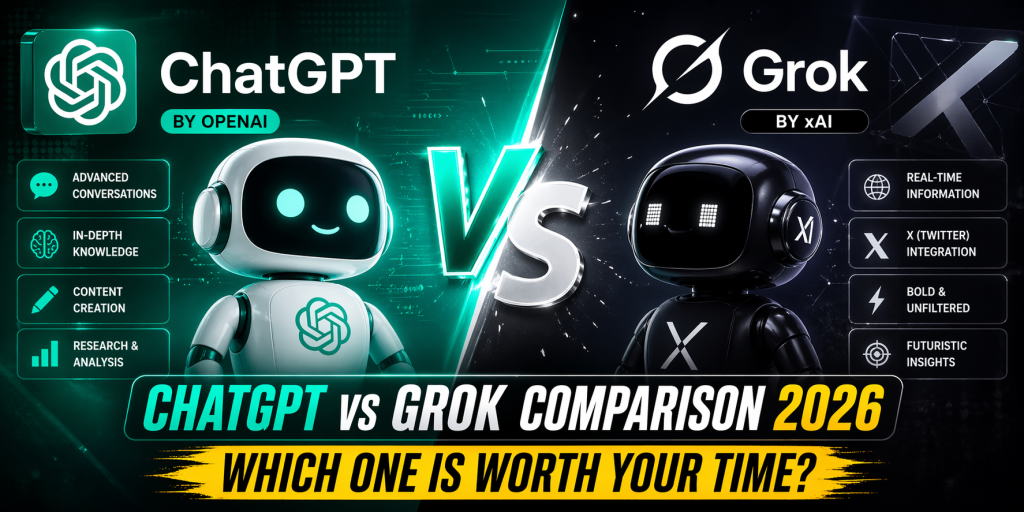
The ChatGPT vs Grok Comparison 2026 has moved past speculation, enough people have used both seriously to finally give honest answers about which one is actually worth paying for.
Here is the problem with most AI tool comparisons.
They are written by people who spent forty minutes with each tool and then declared a winner. Real conclusions come from sustained daily use across different task types, different deadlines, and different professional contexts. That is the only way to know whether a tool actually holds up or just impresses in a demo.
The ChatGPT vs Grok AI comparison that matters in 2026 is not about which model has more parameters or which company has more funding. It is about time. Specifically yours. Which tool deserves to be open on your screen when work actually needs to get done. Professionals across the USA have spent enough time with both now to answer that question with some real confidence.
What Each Tool Is Actually Optimized For
Most people treat this as a competition between equals trying to do the same thing.
They are not.
Grok was shaped by the platform it lives on. X users needed fast, direct, real-time answers. Not lengthy explanations. Not balanced takes that hedge every claim. Just current, useful information delivered quickly and without the corporate filter that makes some AI responses feel like they were reviewed by a legal team before delivery.
ChatGPT was shaped by a fundamentally different set of priorities. Breadth. Reliability. Consistent performance across an enormous range of task types. OpenAI spent years refining it against real user feedback across writing, coding, research, analysis, and complex reasoning. The result is a tool that handles almost anything thrown at it with a level of consistency that narrower tools cannot match.
Understanding this distinction changes how you evaluate everything else.
The Four Areas Where the Gap Is Real
Real-Time Information Access
No ambiguity here.
Grok pulls live data. It knows what happened yesterday, what is trending right now, what was announced this morning. For anyone whose work requires current information, this is not a feature comparison. It is a fundamental capability difference.
ChatGPT without browsing enabled answers based on training data with a cutoff date. That cutoff creates a specific failure mode — confident answers built on outdated context — that erodes trust quickly when you catch it happening.
Depth on Complex Work
Flip the advantage completely.
Long documents that need coherence from start to finish. Multi-step analytical tasks that require holding significant context. Complex code that demands logical consistency across considerable length. ChatGPT performs these more reliably than Grok does right now. The output is more consistent. The reasoning holds together more predictably. The editing required afterward is measurably less.
ChatGPT vs Grok AI comparison on sustained complex work is not particularly close at this point in 2026.
Memory and Personalization
ChatGPT builds a persistent model of how you work over time.
Preferences. Communication style. Recurring context. Projects you return to regularly. Use it seriously for several months and the tool genuinely understands your workflow in ways that make every interaction faster and more relevant than the last.
Grok resets each session. For someone using AI as an occasional research tool that does not matter. For someone building a daily professional workflow around it the difference compounds significantly over time.
Tone and Communication Style
This one is more subjective but it affects daily usability more than most technical comparisons acknowledge.
Grok is direct. It gives opinions when asked for them. It skips the qualifications and disclaimers that pad ChatGPT responses when a simple answer would have been enough. For professionals who find excessive hedging frustrating, Grok feels noticeably more efficient to interact with.
ChatGPT is thorough. Sometimes more thorough than the task requires. For professional contexts where precision and careful qualification matter that thoroughness is an asset. For quick decisions it occasionally gets in the way.
Pricing Laid Out Simply
ChatGPT Plus costs twenty dollars per month. Full GPT-4o access, memory, browsing, image generation, and the custom GPT library are included at that tier.
Grok access comes through X Premium at sixteen dollars per month with real-time capabilities included.
Four dollars a month separates them. That difference should not drive the decision. What each tool actually delivers for that price should.
The ChatGPT vs Grok Comparison 2026 Verdict
Neither tool wins outright. That framing misses the point entirely.
Grok is worth your time when the task requires current information, fast answers, and direct communication. ChatGPT is worth your time when the task requires depth, memory, and sustained quality across complex work.
The professionals across the USA getting the most value from AI right now have stopped asking which tool is better. They know which one fits the moment in front of them and they open that one. That is not indecision. That is just using tools correctly.
Conclusion
As AI tools become the primary way people find information, the businesses showing up inside AI-generated answers are gaining visibility that traditional search rankings no longer guarantee on their own.
NotionX was built to solve exactly that problem. It tracks and improves how your brand appears inside ChatGPT responses, Google AI Overviews, and Perplexity answers. If your competitors are showing up in those results and you are not, that gap is worth closing sooner rather than later.