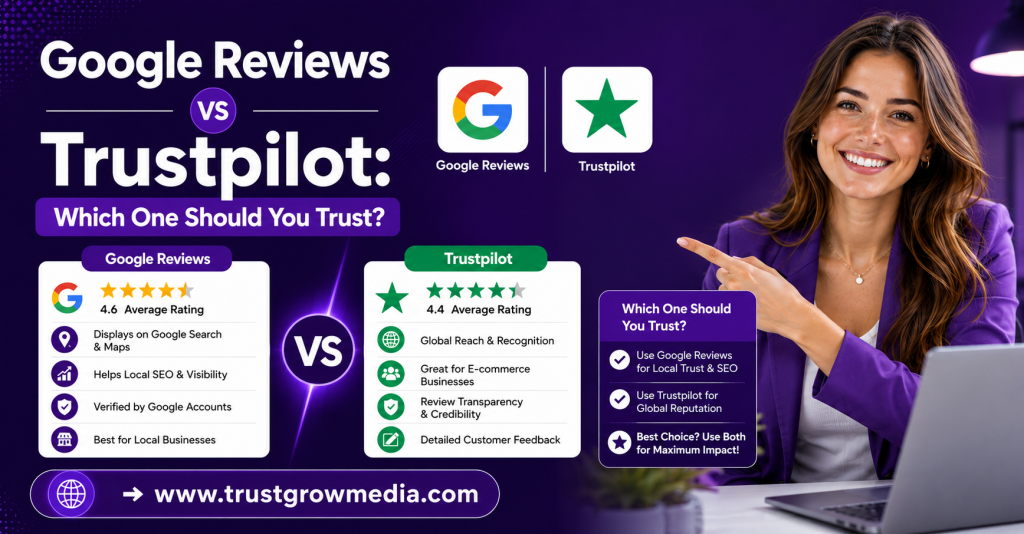
Confused about Google Reviews vs Trustpilot? Discover the key differences, benefits, and which platform you can truly trust for customer feedback.
Key Highlights
- Google reviews help your business profile stand out in local seo and Google Maps.
- Trustpilot reviews work best as an independent review platform for brand research.
- Google reviews are free, while Trustpilot has a free plan and paid options.
- Trustpilot reviews can support seller ratings in ads, unlike a standard Google business profile.
- Google reviews often build faster review volume and a visible star rating.
- Your best choice depends on whether you need local reach, stronger trust signals, or both.
Introduction
Google Reviews and Trustpilot are two of the most recognized review platforms, but each serves different business goals and customer expectations. Choosing the right platform depends on your industry, target audience, and overall marketing strategy. This comparison breaks down their features, strengths, and limitations to help you make an informed decision. For more expert guidance on review management and digital reputation, TrustGroowMedia provides practical insights for modern businesses.
Google Reviews vs Trustpilot: Core Concepts and Key Functions
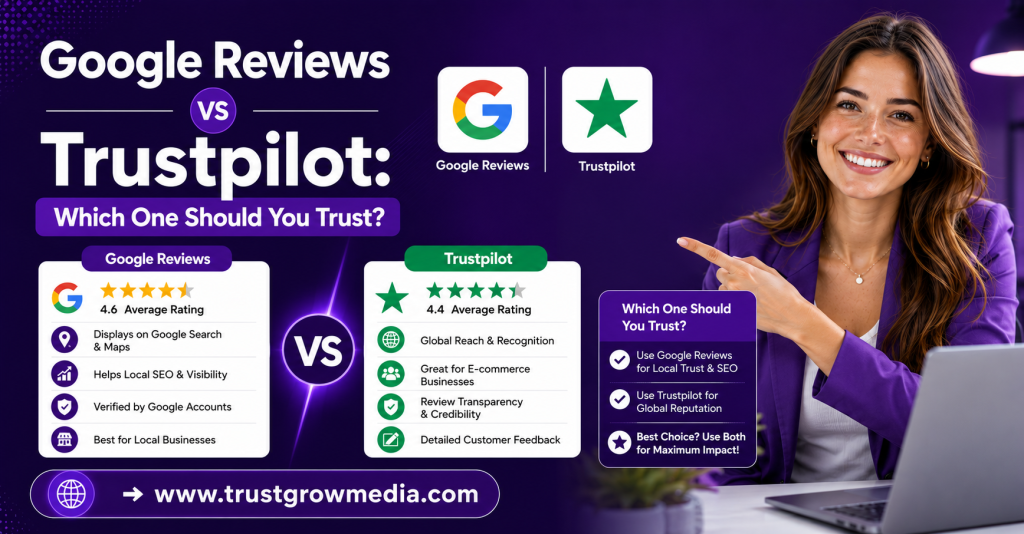
At the core, Google reviews and Trustpilot reviews solve different problems. Google is tied to your business profile, so it helps people find you in Search and Maps. Trustpilot is a dedicated review platform where customers actively research a company’s reputation before buying.
That is the main difference for businesses. Google review requests support discovery, especially for local businesses. Trustpilot review requests support brand trust, especially for ecommerce and SaaS brands. One drives visibility. The other supports decision-making. To see how that plays out, start with each platform on its own terms.
Overview and Purpose of Google Reviews
Google reviews are customer ratings connected directly to your Google Business Profile. When people search your business name or browse Google Maps, they can see your star rating before they visit your website. That makes Google one of the first trust signals many buyers notice.
For local businesses, this matters a lot. A steady flow of Google reviews can improve visibility in local search results and the local pack. More reviews and a higher average rating often help your listing appear stronger when nearby customers are deciding where to go.
The process is also simple. Anyone with a Google account can leave feedback, which helps review volume grow faster. Businesses can send review invitations after a service or purchase, and those reviews appear right on the business profile where new customers are already searching.
How Trustpilot Works and Its Global Reach
Trustpilot is an independent review platform built for reputation research. Instead of living inside Maps, Trustpilot reviews appear on a Trustpilot profile where people go specifically to compare brands, read customer feedback, and judge a company’s reputation before making a purchase.
That focus changes how review collection works. Businesses can send review invitations to customers, and a verified review can receive a badge that signals it came through a more structured process. This helps strengthen trust signals, especially during higher-consideration purchases.
Its reach is also broad. Trustpilot has been used by hundreds of thousands of businesses worldwide, which gives it strong brand recognition across markets. When people search for a company plus reviews, the Trustpilot profile often appears in search results, helping brands build visibility beyond their own website.
Review Visibility and Discoverability Differences
When visibility is the goal, Google reviews and Trustpilot reviews play very different roles. Google places reviews directly on your business profile, where they influence how people see you in search results and Maps. That gives Google a direct local seo advantage.
Trustpilot, by contrast, is a review platform that helps with branded search visibility rather than local rankings. Its pages can appear when people search your business name plus reviews, but they do not improve Maps placement. If you want SEO gains for local discovery, Google is the stronger option. Next, let’s look at why.
Impacts on Local SEO and Online Presence
For local seo, Google clearly has the edge. Google reviews feed into how your Google Business Profile performs in local searches, especially for “near me” queries. If your business depends on foot traffic, calls, or appointments, this can directly shape how often people find you.
Trustpilot does not affect Maps rankings or the local pack. Its value is different. It supports online presence when people search for your brand and want outside opinions before choosing you.
Here is where Google reviews help most in search results:
- They strengthen your Google Business Profile for local searches.
- Higher review volume can improve your visibility in the local pack.
- A stronger rating can make your listing more appealing than nearby competitors.
Customer Decision-Making: Which Platform Influences More?
The answer depends on where the customer is in the buying process. Google reviews often influence earlier action because they appear while people are searching for a business, checking a location, or scanning a quick star rating. That makes them powerful for first impressions.
Trustpilot reviews tend to matter more at the decision stage of the buying journey. When customers are comparing brands, reading detailed opinions, and trying to judge customer trust, they often visit an independent review platform on purpose. That makes Trustpilot especially useful for online purchases and higher-value decisions.
So which gets checked more often? For many U.S. buyers, Google reviews are often seen first. Yet Trustpilot reviews can carry more weight when someone is doing deeper research. The best reading of customer behavior is simple: Google drives discovery, while Trustpilot supports review insights and final reassurance.
Trustworthiness and Credibility of Reviews
Trust matters because every review platform faces the same challenge: fake reviews. Google reviews are easy to leave through a Google account, which helps volume but can also create more risk around spam or suspicious feedback on a business profile.
Trustpilot reviews are often seen as more controlled because the platform puts more focus on fraud detection and structured review collection. That does not make either system perfect. It does mean customers may see Trustpilot as more trustworthy for brand research, while Google remains the more visible everyday source.
Authenticity, Verification, and Moderation Processes
One of the biggest differences between these platforms is how they handle verification and moderation. Google makes leaving feedback easy, which increases participation. The downside is that fake reviews can be harder to prevent and often harder to remove.
Trustpilot uses a more structured process. Businesses can send review requests to customers, and some feedback receives a verified review label. Its stronger fraud detection and abuse monitoring create added trust signals, even though no system catches every problem.
Here is a simple comparison:
| Feature | Google Reviews | Trustpilot |
| Verification | Usually tied to a Google account | Can include verification through invitations |
| Review requests | Often manual or via third-party tools | Built into the platform, especially on paid plans |
| Fraud detection | More limited | Stronger fraud detection and monitoring |
| Fake reviews removal | Often difficult | More active review platform controls |
Are Google Reviews or Trustpilot Reviews Perceived as More Trustworthy?
Perception depends on context. Google reviews feel familiar because they appear where people already search, so they can quickly build customer trust. A visible rating next to a business name often helps buyers make fast judgments without leaving Google.
Still, Trustpilot reviews often carry stronger brand trust for researched purchases. Since Trustpilot is an independent review platform, many people see it as a more neutral place to evaluate a company. That matters when a buyer is comparing options and wants outside validation.
So which is perceived as more trustworthy? For quick local decisions, Google reviews often feel practical and immediate. For deeper reputation checks, Trustpilot reviews may seem more credible because of their independent setting and stronger moderation approach. Customers often trust both, but for different reasons.
Cost Structures: Free vs Paid Review Management
Cost is one of the clearest differences. Google reviews are free. You can collect them, reply to them, and manage a listing without paying for a subscription. For many businesses, that makes Google the easiest starting point.
Trustpilot reviews come with a free plan, but it is limited. Businesses that want more review collection capacity, automation, and advanced features usually need paid plans. Entrepreneurs often pay because they want stronger brand trust, better tools, and access to ad-related benefits that Google reviews alone do not provide.
Why Businesses Invest in Trustpilot Compared to Free Google Reviews
At first glance, paying for Trustpilot seems odd when Google is free. But the decision usually comes down to business goals. If your buyers spend more time researching before purchase, an independent platform can influence them at the decision stage of the buying journey in ways Google may not.
That is especially true for ecommerce brands, SaaS companies, and service businesses without a strong local presence. In those cases, Trustpilot reviews become part of the conversion path rather than just a visibility tool.
Businesses often choose paid plans because they want:
- More structured review collection through invitations
- Stronger reputation support during the buying decision
- Features that align with advertising and brand trust goals
For the right company, the investment is less about reviews alone and more about sales support.
What Do Paid Features Offer on Trustpilot?
Trustpilot’s paid tiers are designed for businesses that want more control and more data. The free level covers basic features, but it limits review invitations and does not open the full feature set used by teams running a more active review strategy.
With paid access, businesses can automate outreach, study feedback patterns, and work from a stronger dashboard. That makes Trustpilot more useful for brands that depend on repeat reporting and long-term optimization.
Paid tiers commonly help you:
- Send more review invitations with less manual work
- Access advanced features and deeper review insights
- Use deep analytics to track trends over time
If your team needs structured workflows and measurable reporting, those tools can justify the monthly cost.
Integrations, Tools & Marketing Advantages
Beyond reviews themselves, the real difference often shows up in marketing tools. Google reviews support your business profile and help with visibility, but they do not connect to seller ratings in Google Ads the same way Trustpilot can.
Trustpilot reviews have an edge here because Trustpilot is a Google-approved review platform for certain ad features. That matters for businesses using Google Shopping or search campaigns. It also helps when you want to reuse review content across your website, social media, and other trust-building channels.
Google Reviews and Trustpilot in Google Ads Product Ratings
If your focus is Google Ads, Trustpilot has a practical advantage. Trustpilot is a Google-approved review platform for seller ratings, which means Trustpilot reviews can support the star-based social proof that appears with some ads. This can be especially valuable in competitive search results.
Google reviews do not feed into seller ratings the same way through your standard Business Profile. That surprises many business owners, but it matters if you are counting on ad extensions to improve clicks.
For ecommerce brands using Google Shopping ads, this can be a major reason to invest in Trustpilot. It places trust signals closer to the moment of action. In short, Google reviews help people find you organically, while Trustpilot reviews can strengthen paid visibility through seller ratings where clicks and conversions happen.
Showcasing and Embedding Reviews on Business Websites
Reviews do more than sit on third-party platforms. They also work as social proof on your brand’s own website. That is why many businesses want to display positive reviews near checkout pages, service pages, or homepage sections tied to their business name.
Trustpilot is well known for polished widgets and the recognizable Trustpilot logo. Google reviews can also be embedded, though this often relies on outside tools rather than the basic business profile dashboard alone. Both approaches can help visitors feel more confident before they contact you or buy.
Useful ways to showcase reviews include:
- Add positive reviews to landing pages and product pages
- Place trust badges near forms or checkout areas
- Use review snippets in website sections and social media campaigns
When done well, reviews become visible proof that real customers value your business.
Optimizing Review Strategies for Small and Medium Businesses
For most small business owners, the first question is not whether both platforms matter. It is where limited time should go first. Your review strategy should match your business type, how customers find you, and whether local search results drive your leads.
In many cases, Google reviews deserve the early focus because they help build visibility fast and increase the number of reviews shown in Search and Maps. Trustpilot reviews become more important when your sales process depends on deeper research, brand comparison, or paid campaigns.
Which Review Platform Is Easier to Manage Negative Feedback On?
Managing negative reviews is rarely easy on any review platform, but the experience differs. Google reviews are simple to receive and reply to through your business profile, yet suspicious reviews can be difficult to remove. That can frustrate businesses dealing with spam or unfair comments.
Trustpilot reviews usually come through a more structured system, which can make moderation feel more organized. Its fraud controls are stronger, though some businesses still say negative feedback can be hard to challenge when the platform does not find a clear policy issue.
In practical terms, each platform has tradeoffs:
- Google reviews are easier to monitor because they sit on your business profile
- Trustpilot reviews may be easier to assess through a more controlled system
- Review requests can help reduce surprise feedback by creating a steady, balanced flow
Choosing the Right Platform Based on Your Business Needs
The right choice depends on your business goals, not on which platform seems more popular. These tools solve different problems. If you run a salon, clinic, or repair service, local visibility may matter most. If you sell online across regions, reputation research may carry more weight.
Your business type and competitive space should shape your review strategy. Local businesses usually gain more from strong Google review volume. Brands in ecommerce or SaaS often benefit more from Trustpilot’s role in comparison shopping and paid visibility.
Ask yourself these questions:
- Do customers discover you through Maps or through branded online research?
- Is review volume more important than structured verification?
- Do you need a review platform for local reach, ad support, or both?
That framework usually makes the decision much easier.
Conclusion
In conclusion, understanding the differences between Google Reviews and Trustpilot is crucial for businesses looking to enhance their online reputation. Both platforms offer unique advantages, from influencing customer decision-making to impacting local SEO. By evaluating your specific business needs and customer preferences, you can make an informed choice that aligns with your goals. Remember, the credibility of reviews plays a significant role in shaping consumer trust, so it’s essential to actively engage with either platform. If you’re ready to take your review strategy to the next level, consider reaching out for a free consultation to explore how to maximize your online presence and drive customer trust.
Frequently Asked Questions
Is it common for businesses to pay for 5-star reviews on either platform?
Some businesses do try paid reviews, but that creates fake reviews and damages trust. On both google reviews and trustpilot reviews, buying ratings breaks the spirit of a fair review platform. Short-term gains are risky, and suspicious patterns can hurt reputation far more than they help.
For a U.S. business website, which review platform do customers check more often before purchase?
For many U.S. buyers, google reviews are often seen first because they appear in Search and Maps. Still, trustpilot reviews are commonly checked before purchase on ecommerce platforms when people want stronger customer trust and more detailed brand research from an independent review platform.
What are the most important factors when deciding between Google Reviews and Trustpilot?
Focus on how customers find you, what builds trust fastest, and whether you need local visibility or brand research support. Google reviews are best for business profile strength and visible star rating in local search. Trustpilot reviews are better when an independent review platform matters more to conversions.