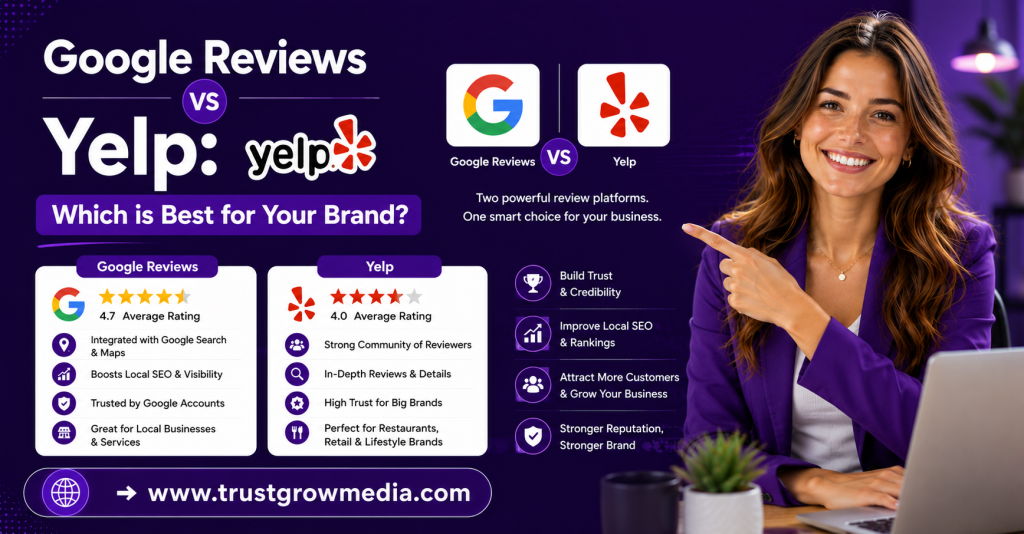
Discover the key differences between Google Reviews vs Yelp and how they can impact your brand’s reputation. Read more in our latest blog post!
Key Highlights
- Google reviews usually give business owners more visibility because they appear in Search and Maps.
- Yelp reviews often feel more detailed, which can help a brand build trust with a specific audience.
- Each review platform attracts different behavior, from quick ratings to longer online reviews.
- Google reviews are easier to leave, so they often bring higher review volume.
- Yelp reviews use stricter filtering, which can improve perceived quality but frustrate business owners.
- Your best choice depends on whether you want reach, depth, or both.
Introduction
When building an online reputation, many businesses compare Google Reviews and Yelp to determine which platform delivers the greatest value. Both influence customer decisions, but they differ in audience reach, search visibility, and review management features. This guide compares the two platforms so you can decide which best supports your brand’s long-term success. For more helpful marketing insights, TrustGroowMedia offers trusted resources for businesses looking to improve their online presence.
Comparing Google Reviews and Yelp in the United States
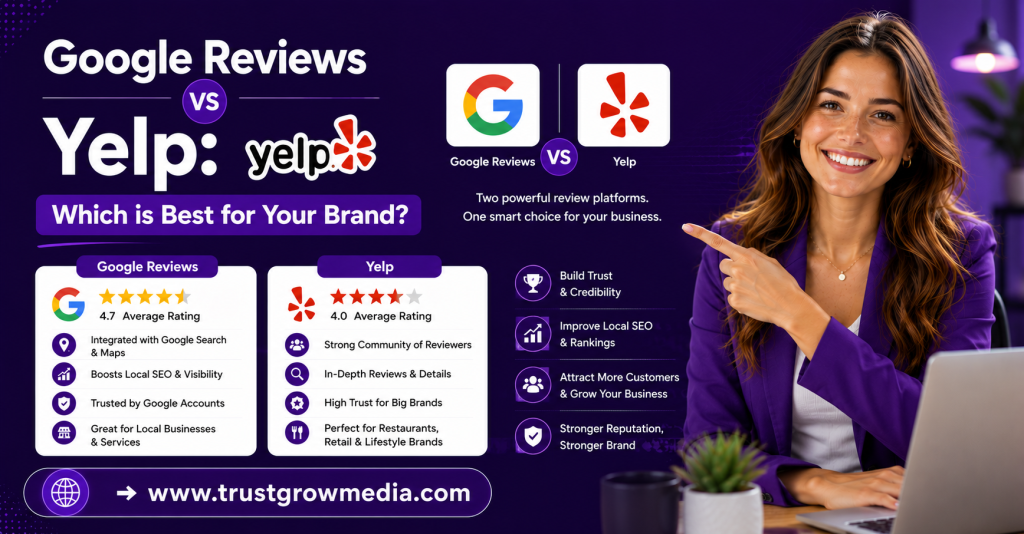
Across the United States, Google reviews usually reach more people because they appear directly in search results and Google Maps. That gives local businesses a strong advantage when customers search for nearby options.
Yelp reviews still matter, especially for restaurants, salons, home services, and city-based brands. In some categories, Yelp has a loyal audience that reads carefully before choosing. To see how these platforms differ in day-to-day use, it helps to start with a simple overview.
Brief Overview of Google Reviews and Yelp
Google reviews are tied to a business listing on Google and are visible in Google Search and Maps. Anyone with a Google account can usually post quickly, which makes Google one of the easiest review sites for everyday users. That ease often leads to more ratings and faster feedback.
Yelp reviews work differently. A user needs a Yelp account, and Yelp’s community is more focused on writing longer, more detailed experiences. The platform is especially popular for dining, local service businesses, and other neighborhood-based decisions.
The main differences between Google reviews and Yelp reviews come down to visibility, access, and style. Google offers broader reach and lower barriers. Yelp offers a more selective environment, with stronger filtering and a reputation for detailed write-ups. So if you want scale, Google often wins. If you want depth, Yelp can stand out.
Importance of Online Reviews for Brands
Online reviews now shape how people judge your business before they ever call, visit, or buy. A strong online reputation can push a customer toward your brand, while weak feedback can send them elsewhere. That is why your business profile needs attention on every major platform your audience uses.
On Google, your Google Business Profile can influence how easily people discover you in local searches. On Yelp, your Yelp profile can help shoppers compare experiences in more detail. Together, these signals guide local customer decisions in practical ways:
- They create first impressions through ratings and recent comments.
- They help customers judge quality, service, and consistency.
- They make your brand look active when you respond and keep profiles current.
In simple terms, reviews affect both trust and action. People use them as social proof. If your profiles look cared for, your brand feels easier to choose. Next, it helps to compare the platforms side by side.
Key Differences Between Google Reviews and Yelp
The biggest gap between Google reviews and Yelp reviews is reach. Google has wider market share in everyday search behavior, so it often becomes the first review platform people see. That gives it a strong edge for visibility.
Yelp plays a narrower but still important role. Its audience is more focused, and its review culture leans toward longer write-ups and stronger filtering. For brands, that means the better platform depends on whether you need broad discovery or a more selective audience. The next sections break that down clearly.
User Base and Market Presence
Google has the larger user base because so many people already have a Google account. That creates broader reach and makes review activity feel more natural during daily search behavior. For many businesses, that means more views, more ratings, and more chances to get noticed.
Yelp users form a more specific audience. They are often more engaged and more likely to leave longer comments. That can make Yelp feel more curated, even though the platform reaches fewer people overall than Google.
| Factor | Google Reviews | Yelp Reviews |
| User base | Very large, tied to everyday Google account use | |
| Reach | Broader reach across search and maps | |
| Audience style | Quick ratings and shorter feedback | |
| Yelp users equivalent | Smaller but more active reviewing community | |
| Business presence | Strong for general discovery | Strong for a specific audience through a Yelp profile |
If you ask which platform has more reliable reviews, Yelp often feels stricter, while Google feels more open. Reliability depends on whether you value scale or tighter filtering.
Review Posting Process and Ease of Use
For most people, Google has the simpler review posting process. If someone already has a Google account, they can leave quick feedback with very little friction. That ease of use helps businesses collect more responses, especially when they share a direct review link after a visit or purchase.
Yelp asks more from the reviewer. A person needs a Yelp account, and even then, some reviews may be filtered by the platform. That can slow participation and make the experience feel less direct for casual users.
Here is the practical difference:
- Google is easier for fast star ratings and short comments.
- Yelp requires more effort, which can reduce casual participation.
- A shared review link works especially well on Google when you want more volume.
So, which platform is easier for users to leave reviews on? Google, by a clear margin. Yelp is better suited to people who already use the platform regularly.
Review Authenticity and Trustworthiness
When you look at fake reviews, the debate becomes more complex. Google’s open system brings more participation, but that also means suspicious posts can slip through. Volume is helpful, yet it does not always guarantee accuracy.
Yelp takes a tougher stance, which leads many people to see its content as more trustworthy reviews. Still, strict filtering can also hide genuine reviews. In other words, both platforms are useful, but each handles trust in a very different way. That difference matters for brand perception.
Review Moderation and Fake Review Detection
Review sites use different systems to manage fake reviews and protect review quality. Google allows businesses to report content that appears misleading, spammy, or against the rules. Still, its moderation is lighter, so some questionable posts may remain visible.
Yelp’s algorithm is more aggressive. It may label some posts as not recommended if they appear biased or untrustworthy. That approach can help reduce inappropriate reviews, but it can also frustrate businesses when valid comments get filtered out.
In practice, review platforms handle fake or unverified reviews like this:
- Google relies on reporting tools and enforcement under Google’s policies.
- Yelp’s algorithm automatically filters reviews it considers suspicious.
- Both systems aim to protect review quality, but neither is perfect.
If you want stronger filtering, Yelp often feels stricter. If you want openness and scale, Google offers that, though with more risk of weak moderation.
Reviewer Verification Policies
Neither review platform works like a formal identity check, but both require user accounts. On Google, a person needs a Google account to post. Because so many people already use Google products, the barrier is low, and the process feels fast.
Yelp also requires an account, yet its environment is more selective. A Yelp account alone does not guarantee the review will stay fully visible. The platform’s filtering system adds another layer that shapes which comments appear more prominently.
So, do Google Reviews or Yelp have stricter reviewer verification? Based on how the platforms operate, Yelp is stricter in practice, even if not through traditional reviewer verification. Google is easier to access, while Yelp applies tighter control after submission. That difference affects both review volume and how trustworthy the final review mix may appear.
The Role of Google Reviews and Yelp in Local Search
Google reviews have a direct connection to local search because they appear inside Google search results and Maps. That means they can influence what people see first when they look for nearby options.
Yelp reviews matter too, but their influence is usually stronger inside Yelp itself or when Yelp pages rank in Google search. For brands, this creates two paths to discovery: one led by Google’s ecosystem and one led by Yelp’s community. Understanding that split helps explain how each platform supports visibility.
Influence on Local SEO Rankings
Google reviews play a significant role in local SEO. Because they sit inside Google search and Maps, they can help improve visibility in local search results. Businesses with more active feedback and responses often appear stronger in Google’s local ecosystem, which supports a better online presence.
Yelp works differently. Yelp pages can appear in Google search, but Yelp reviews do not directly boost a business’s Google rankings the same way. Their SEO impact is more indirect, helping through platform visibility rather than through Google’s core local signals.
Here is how they influence local customer decisions:
- Google reviews affect discovery, ranking, and first-click behavior.
- Yelp pages can still attract clicks when they rank for category searches.
- A strong profile on either platform supports trust before a customer contacts you.
In the search engine market, Google has the bigger SEO advantage. Yelp still matters, but more as a supporting channel than a primary ranking driver.
Visibility in Google Search vs. Yelp Search
In Google Search, a business can appear with star ratings, location details, and a map listing right away. That makes discovery fast. A Google business listing often shows your business name, contact details, hours, and customer sentiment before someone even visits your website.
Yelp search is more platform-centered. People usually browse within Yelp pages to compare experiences, read longer comments, and evaluate service quality. A single Yelp review may carry more detail, but it usually takes more effort for the user to find it unless they are already on Yelp.
That is one of the main differences between the two platforms. Google Maps and Search favor convenience and wide exposure. Yelp favors deeper comparison within its own environment. If your goal is immediate visibility, Google stands out. If your goal is detailed decision support, Yelp search has clear value, especially for high-consideration local choices.
Impact of Reviews on Consumer Decisions
Online reviews influence choices because people use them to reduce uncertainty. A strong rating can make a business feel safer, while weak feedback creates hesitation. That is the heart of consumer trust.
At the same time, social proof is not just about stars. Detailed reviews often carry extra weight because they explain what actually happened. Some shoppers want speed, others want context. That is why both Google and Yelp can shape decisions in different ways. The details behind the rating often matter as much as the rating itself.
How Customers Interpret Ratings and Feedback
Customers rarely look at a star rating alone. They also study review quality, recent comments, and whether the tone feels believable. A business with many positive reviews may look strong at first glance, but one sharp negative review can still affect the final decision.
People often compare platforms differently. On Google, they may scan for trends. On Yelp, they may spend more time reading detailed feedback before making up their mind. The number of reviews also matters because it can make a rating feel more stable.
Customers usually look for:
- A strong but believable star rating
- Enough detailed feedback to explain the experience
- A healthy number of reviews over time
- How the business handles a negative review
So how do these platforms influence local customer decisions? Google helps with quick filtering. Yelp often helps with careful confirmation.
Why Ratings Differ Across Platforms
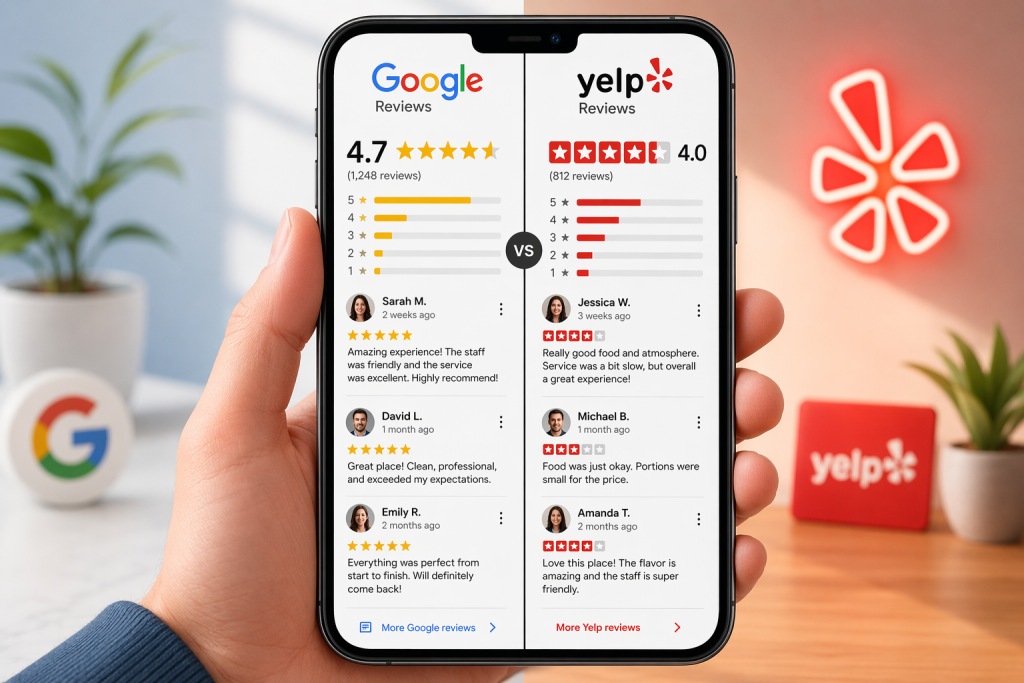
It is common for the same business to have different scores on Google reviews and Yelp reviews. One reason is review volume. Google usually collects more ratings because it is easier to use, and that larger pool can smooth out extreme opinions.
Yelp often shows fewer but more detailed reviews. Since the audience is different and the platform filters aggressively, the visible sample may not match what appears on Google. A single bad review can also feel more noticeable when the total review count is lower.
Ratings differ because the platforms attract different behaviors, different users, and different levels of filtering. Google often reflects wider public sentiment. Yelp may reflect a more selective reviewing group. If you see a gap between the two, it does not always mean one is wrong. It usually means each platform is capturing a different slice of customer experience.
Conclusion
In conclusion, understanding the differences between Google Reviews and Yelp is crucial for any brand looking to enhance its online presence. Both platforms have unique features that can significantly impact consumer decisions and local SEO rankings. Google Reviews offers visibility in general search results, while Yelp is often favored for more specific searches related to service industries. By leveraging both platforms effectively, businesses can build credibility, engage with customers, and ultimately drive more traffic. Don’t miss the opportunity to enhance your brand’s online reputation—start gathering reviews today! If you’d like to learn more about optimizing your presence on these platforms, feel free to reach out for assistance.
Frequently Asked Questions
Should businesses focus more on Google Reviews or Yelp for building their brand?
Most business owners should start with Google Reviews because that review platform has stronger visibility in Search and Maps. Yelp reviews still matter, especially for restaurants, home services, and city-based brands. For the best online reputation, focus first on where your customers are most likely to look.
Are Yelp reviews generally considered more reliable than Google Reviews?
Yelp reviews are often seen as more trustworthy because Yelp filters aggressively. That can reduce fake reviews, though it may also hide some genuine reviews. Google reviews are broader and easier to collect, but that openness can allow more questionable content to appear.
Is it important to check both Google Reviews and Yelp before choosing a restaurant or service?
Yes, checking both Google reviews and Yelp reviews gives you a fuller picture. Google online reviews help you spot general patterns fast, while Yelp often adds more detail. For local businesses, using both sources of social proof can help you make a more confident choice.