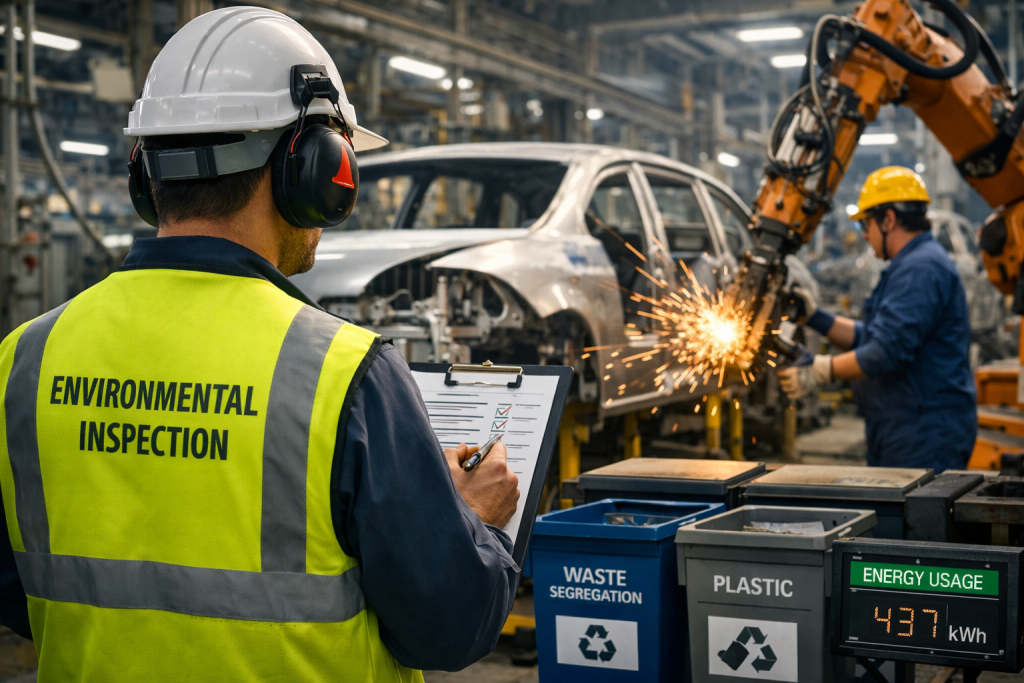
The shop floor doesn’t lie
You can write procedures, circulate policies, and hold as many review meetings as you want—but the real story of ISO 14001 certification unfolds on the shop floor. That’s where raw materials turn into components, where machines hum (or sometimes groan), and where waste—visible and invisible—takes shape.
When ISO 14001 certification is properly introduced, it doesn’t sit quietly in manuals. It shows up in how operators handle materials, how supervisors track usage, and even how maintenance teams respond to leaks or inefficiencies. At first, people might see it as “another system.” But slowly, almost without anyone announcing it, awareness builds.
Operators begin to notice patterns. A recurring spill. Excess scrap from a specific machine. Unusual energy spikes during certain shifts. And that’s when ISO 14001 certification starts doing its real job—not enforcing rules, but shaping observation.
Cost and waste—closer than you think
Let me explain something that often surprises even experienced production managers: environmental waste and operational cost are almost always connected. Not loosely. Directly.
ISO 14001 certification helps automotive manufacturers uncover that relationship in a structured way. It encourages teams to look at processes not just for output quality, but for resource efficiency. And once that lens is applied, inefficiencies don’t stay hidden for long.
Think about it—extra material usage, unnecessary energy consumption, or poor waste segregation all translate into money slipping through the cracks. It’s not dramatic, but it’s consistent.
Key points:
- Excess raw material usage increases production cost per unit
- Inefficient energy use often signals aging or poorly maintained equipment
- Waste disposal errors can lead to additional handling or compliance costs
- Small process improvements often lead to steady financial savings over time
So yes, ISO 14001 certification talks about the environment—but it quietly improves the bottom line too.
Risk doesn’t always knock first
Here’s the tricky part about environmental risk in automotive manufacturing—it rarely announces itself. It builds quietly in the background.
A minor chemical spill here. Slightly higher emissions there. Improper storage that “seems fine” for now. Individually, these don’t feel urgent. Collectively, they can turn into something much bigger.
ISO 14001 certification introduces a way to look at these situations differently. Instead of waiting for problems to escalate, it pushes teams to identify and assess risks early. It’s less about reacting and more about noticing.
And honestly, that shift—though subtle—changes everything. Teams begin asking questions they didn’t ask before. “What could go wrong?” becomes just as important as “What’s happening now?”
Suppliers are paying attention
You might not see it directly, but your environmental performance is being observed—especially if you’re part of a larger automotive supply chain.
OEMs and global partners are no longer focused only on quality and delivery timelines. They’re also evaluating how responsibly components are produced. And this is where ISO 14001 certification quietly strengthens your position.
It signals that your processes are structured, your impacts are monitored, and your improvements are ongoing. You don’t have to explain everything repeatedly—the certification speaks for itself.
Key points:
- Builds trust with OEMs and international clients
- Improves supplier approval chances
- Reduces repeated environmental assessments from customers
- Enhances long-term business relationships
It’s not just a certificate—it’s a form of credibility that travels ahead of you.
Culture shift—slow, uneven, but real
Let’s be honest—no system changes workplace culture overnight. And ISO 14001 certification is no exception.
At the beginning, there’s hesitation. Some employees see it as extra work. Others might not fully understand its purpose. A few might even ignore it, hoping it fades into the background.
But it doesn’t.
Instead, it gradually becomes part of daily routines. Documentation becomes more consistent. Discussions around waste and efficiency become more common. Supervisors begin linking environmental impact with operational decisions.
It’s not perfect. It’s not smooth. But it’s real.
And over time, ISO 14001 certification stops feeling like an external requirement. It becomes part of how the organization thinks.
The implementation journey—messy, but worth it
If you’re expecting a neat, step-by-step process, you might be in for a surprise. Implementing ISO 14001 certification feels more like adjusting a moving system than building something from scratch.
There are moments of confusion—too many documents, unclear responsibilities, overlapping tasks. Teams might struggle to connect theory with practice.
And then, gradually, things start aligning.
Processes become clearer. Roles become more defined. Teams begin to understand not just what they need to do, but why it matters.
That’s when ISO 14001 certification starts feeling less like a project and more like a working system.
Audits—less chaos, more clarity
Audits often come with a certain reputation—stressful, demanding, and sometimes unpredictable. And yes, ISO 14001 certification does involve audits.
But here’s the thing: when the system is genuinely in place, audits feel different.
Instead of scrambling for documents or rushing to fix gaps at the last minute, teams simply demonstrate what they already do. The focus shifts from preparation to presentation.
Key points:
- Consistent systems reduce last-minute audit stress
- Documentation becomes easier to manage over time
- Teams gain confidence in explaining their processes
- Audits turn into structured evaluations rather than surprises
It doesn’t eliminate pressure entirely, but it replaces chaos with clarity.
It’s not just compliance—it’s understanding your own operations
One of the most overlooked benefits of ISO 14001 certification is how deeply it helps you understand your own processes.
Automotive manufacturing is complex—multiple stages, interconnected systems, constant movement. It’s easy to focus only on output and overlook the bigger picture.
ISO 14001 certification brings that bigger picture into focus.
You start seeing how energy flows through your plant. How waste is generated at different stages. How small changes in one area affect another.
And once you see those connections, decision-making becomes more informed. Not perfect—but definitely sharper.
Where Integrated Assessment Service comes in
Working with a certification body like Integrated Assessment Service adds structure to the entire journey.
It’s not just about issuing ISO 14001 certification. It’s about guiding automotive manufacturers through the process in a way that makes sense. The goal isn’t to overwhelm—it’s to clarify.
A good certification experience feels less like an inspection and more like a structured review. Questions are asked, systems are evaluated, and improvements are suggested—not imposed.
And in a fast-moving manufacturing environment, that kind of approach makes a noticeable difference.
Long-term gains—quiet but consistent
ISO 14001 certification doesn’t usually deliver instant results. There’s no dramatic turning point where everything suddenly improves.
Instead, the benefits build slowly.
Processes become more consistent. Resource use becomes more controlled. Unexpected issues become less frequent.
Over time, these small improvements add up.
You might not notice them day to day. But over months and years, the difference becomes clear—both operationally and financially.
A quick reality check—it’s not perfect
It’s worth saying this clearly: ISO 14001 certification isn’t flawless.
There are challenges. Documentation can feel heavy at times. Implementation requires effort. Some requirements might feel overly structured, especially in fast-paced environments.
But here’s the trade-off—structure brings consistency.
And in automotive manufacturing, where precision and repeatability matter, that consistency is valuable.
So, is ISO 14001 certification worth it?
That depends on how it’s approached.
If treated as a checkbox exercise, ISO 14001 certification will feel like an obligation—something to complete and move past.
But if it’s treated as a system—a way to understand operations, reduce waste, and manage risk—it becomes something else entirely.
Something practical. Something useful.
Something that supports how automotive manufacturers actually work.
Final thoughts—keeping it practical
ISO 14001 certification doesn’t promise perfection. It doesn’t eliminate challenges or guarantee instant improvements.
But it does something important.
It creates awareness.
It introduces structure.
It encourages steady improvement.
And in an industry as demanding as automotive manufacturing, those things matter more than they might seem at first.
So yes, it takes effort. It takes time. It requires commitment.
But once ISO 14001 certification becomes part of everyday operations, it stops feeling like an external requirement.