Agriculture is entering a new era shaped by climate variability, technological innovation, and growing pressure to produce more food with fewer resources. Across the globe, farmers are confronting increasingly unpredictable weather patterns that challenge traditional farming practices and place greater emphasis on data-driven decision-making.
From prolonged droughts and sudden downpours to shifting growing seasons, climate variability is changing how agricultural operations are managed. At the same time, advances in precision agriculture, drone technology, artificial intelligence (AI), and remote sensing are providing farmers with new tools to identify risks earlier and respond more effectively.
As agricultural producers seek ways to improve resilience and maintain productivity, technology is becoming an essential part of modern farm management.
Why Water-Related Farming Challenges Are Increasing
Water has always been one of agriculture’s most critical resources. However, managing it effectively is becoming increasingly difficult.
According to climate researchers, many regions are experiencing more frequent weather extremes. Heavy rainfall events are becoming more intense in some areas, while others face extended periods of drought. These fluctuations create complex challenges for crop producers, irrigation managers, and agribusiness operators.
Excessive rainfall can saturate soils, damage root systems, delay planting schedules, and reduce crop yields. Meanwhile, prolonged dry periods can stress crops and increase irrigation demands.
The challenge is no longer simply obtaining water. Instead, farmers must manage both shortages and excesses within the same growing season.
Understanding conditions such as waterlogging in agriculture has therefore become increasingly important. Agronomists and technology providers are using new monitoring tools to help identify vulnerable areas before crop damage becomes severe, enabling more informed management decisions.
Climate Variability Changes the Risk Equation
Historically, agricultural planning relied heavily on seasonal averages and long-term experience. Today, those assumptions are becoming less reliable.
Rainfall distribution can vary dramatically within a single season. Fields that remained productive for decades may suddenly experience drainage issues, soil erosion, or unexpected moisture stress.
As a result, farmers are increasingly turning to real-time monitoring systems that provide continuous insights into changing field conditions.
The Economic Impact on Crop Production
Water-related challenges affect more than crop health. They also influence farm profitability, supply chains, and food security.
Crop losses resulting from flooding, excessive moisture, or poor drainage can reduce yields and increase production costs. In many cases, growers must invest additional resources in replanting, soil remediation, or disease management.
Furthermore, wet field conditions often limit equipment access, delaying critical operations such as planting, fertilization, and harvesting.
Rising Costs Across the Agricultural Sector
The financial consequences extend beyond individual farms.
Food processors, commodity traders, and agricultural suppliers also feel the effects when production declines. Reduced harvest volumes can lead to higher commodity prices, increased market volatility, and disruptions throughout agricultural supply networks.
For large agribusinesses managing thousands of acres, even small inefficiencies can translate into significant financial losses.
Consequently, technologies that improve visibility into field conditions are attracting growing interest from both producers and investors.
How Precision Agriculture Is Evolving
Precision agriculture has transformed significantly over the past decade. What began as a system focused on GPS-guided equipment and variable-rate applications has evolved into a comprehensive ecosystem of sensors, software, and predictive analytics.
Modern precision farming integrates data from multiple sources, including:
- Satellite imagery
- Soil sensors
- Weather stations
- Irrigation systems
- Farm machinery
- Drone-based aerial surveys
By combining these datasets, farmers gain a more detailed understanding of field conditions than ever before.
From Reactive to Predictive Farming
One of the most important shifts is the move from reactive management to predictive decision-making.
Rather than responding after visible crop damage occurs, growers can increasingly identify early warning signs and take preventative action.
Machine learning models now analyze environmental data to detect patterns associated with drainage issues, nutrient deficiencies, pest outbreaks, and crop stress.
These insights help producers allocate resources more efficiently while reducing unnecessary inputs.
The Growing Role of Drones and Aerial Intelligence
Among emerging agricultural technologies, drones have become one of the most influential tools for field monitoring.
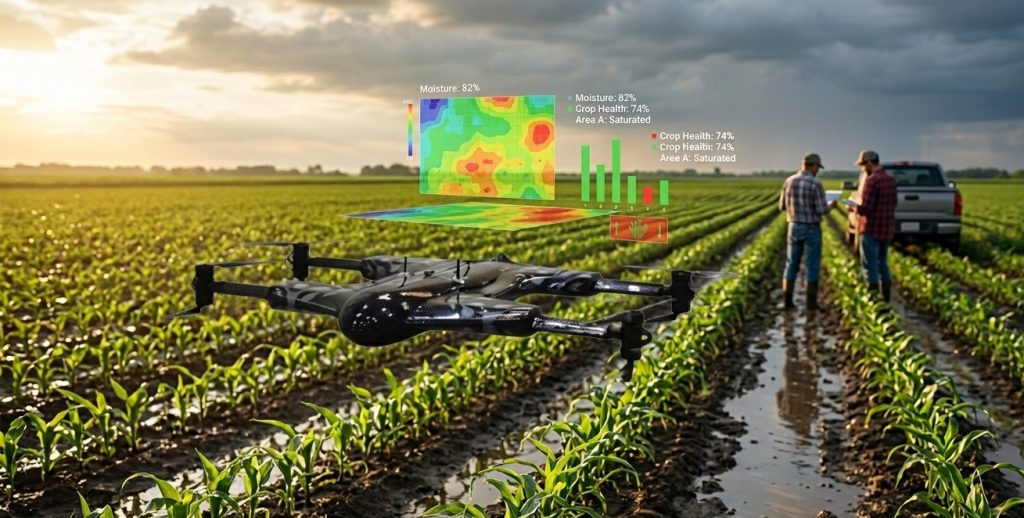
Agricultural drones provide a unique perspective that is difficult to achieve through ground inspections alone. Equipped with advanced sensors and high-resolution cameras, they can rapidly assess large areas and identify conditions that may not be visible from the ground.
This capability is especially valuable in regions facing increasing weather variability.
Faster Detection of Field Conditions
Drone-based surveys allow operators to capture detailed imagery shortly after rainfall events or irrigation cycles.
The resulting data can reveal:
- Poor drainage zones
- Standing water accumulation
- Soil saturation patterns
- Crop stress indicators
- Field variability
Instead of relying solely on visual inspections, growers can analyze objective data and prioritize areas requiring intervention.
Beyond Traditional Visual Imaging
Today’s agricultural drones often carry multispectral, thermal, and LiDAR sensors.
Multispectral imaging helps assess plant health by measuring light reflectance across different wavelengths. Thermal imaging identifies temperature variations associated with moisture stress or irrigation inefficiencies. LiDAR systems generate highly detailed elevation maps that assist with drainage planning and water management.
Together, these technologies provide a comprehensive picture of field conditions.
AI-Powered Analytics Are Changing Farm Management
Collecting data is only part of the equation. The real value comes from turning information into actionable insights.
This is where artificial intelligence is becoming increasingly important.
AI systems can process vast quantities of agricultural data far faster than human analysts. By identifying trends and anomalies, these platforms help producers make informed decisions with greater confidence.
Real-Time Decision Support
AI-powered farm management platforms increasingly offer real-time recommendations related to:
- Irrigation scheduling
- Nutrient management
- Disease risk assessment
- Yield forecasting
- Resource allocation
As computing power improves, predictive models continue becoming more accurate and accessible.
For many agricultural businesses, the ability to anticipate problems before they affect production represents a significant competitive advantage.
Integrating Multiple Data Sources
One of AI’s greatest strengths lies in its ability to combine information from diverse systems.
Weather forecasts, satellite imagery, drone surveys, soil data, and equipment telemetry can all be analyzed together to generate a unified view of farm performance.
This integrated approach supports more precise and efficient decision-making across agricultural operations.
Future Technology Trends in Agriculture
The next generation of agricultural innovation is expected to focus on automation, connectivity, and predictive intelligence.
Several trends are gaining momentum across global farming markets.
Autonomous Field Operations
Autonomous tractors, robotic sprayers, and self-guided agricultural equipment are becoming increasingly sophisticated.
These technologies aim to improve efficiency while reducing labor requirements and operational costs.
As labor shortages continue affecting agricultural regions worldwide, automation is likely to play a larger role in farm management.
Digital Twins for Agriculture
Digital twin technology is also attracting attention.
A digital twin creates a virtual representation of a farm, field, or production system using real-world data inputs. Farmers can simulate different scenarios and evaluate potential outcomes before making management decisions.
This approach could significantly improve risk management in highly variable environments.
Expanded Use of Edge Computing
Edge computing allows data processing to occur closer to where information is collected rather than relying entirely on cloud-based systems.
For agricultural operations located in remote areas, edge computing can enable faster analysis and more reliable decision-making even when internet connectivity is limited.
What Farmers and Agribusinesses Can Expect Next
The agricultural sector is unlikely to become less complex in the coming years. Climate uncertainty, resource constraints, and market pressures will continue influencing how food is produced.
However, technology is providing new opportunities to address these challenges.
Farmers are increasingly adopting integrated systems that combine aerial monitoring, predictive analytics, sensor networks, and automated equipment into unified management platforms.
For agribusinesses, this transition represents more than a technological upgrade. It reflects a broader shift toward evidence-based decision-making and operational resilience.
Data as a Strategic Asset
Data is rapidly becoming one of agriculture’s most valuable resources.
Organizations that effectively collect, analyze, and act on agricultural data may be better positioned to manage risks, optimize production, and adapt to changing environmental conditions.
As adoption expands, data-driven agriculture is expected to become the standard rather than the exception.
Conclusion
Agriculture stands at the intersection of climate change and technological innovation. Increasingly unpredictable weather patterns are creating new challenges related to water management, crop productivity, and operational efficiency.
At the same time, advances in precision agriculture, drone technology, AI-powered analytics, and remote sensing are giving producers unprecedented visibility into field conditions. These tools enable earlier detection of problems, more informed decision-making, and improved resource management.
While no technology can eliminate climate-related risks entirely, data-driven farming is helping agricultural stakeholders respond more effectively to an increasingly complex environment. As these technologies continue to mature, they are likely to play a central role in shaping the future of global agriculture.
FAQs
1. How does climate variability affect modern agriculture?
Climate variability creates unpredictable growing conditions, including extreme rainfall, droughts, temperature fluctuations, and shifting seasons. These factors can impact crop yields, soil health, and farm profitability.
2. What is precision agriculture?
Precision agriculture uses technologies such as sensors, GPS systems, satellite imagery, drones, and analytics platforms to optimize farming decisions and improve resource efficiency.
3. How do drones help farmers manage water-related challenges?
Drones provide aerial imagery and sensor data that help identify drainage issues, standing water, soil saturation, and crop stress, allowing farmers to respond more quickly and effectively.
4. What role does artificial intelligence play in agriculture?
AI analyzes large volumes of agricultural data to provide insights related to irrigation, crop health, disease risk, yield forecasting, and operational planning.
5. What technologies are expected to shape the future of farming?
Key emerging technologies include autonomous farm equipment, AI-powered analytics, digital twin systems, advanced drone platforms, IoT sensor networks, and edge computing solutions for real-time decision-making.