Wondering, “Are Google Reviews Fake?” Discover the truth behind online reviews and how to spot real feedback in our informative blog post.
Key Highlights
- A Google review can strongly shape how potential customers judge a business profile.
- Not all online reviews are false, but fake reviews do appear often enough to matter.
- Genuine reviews usually include clear details, balanced language, and believable timing.
- Fake reviews can hurt trust, damage rankings, and weaken a business profile over time.
- Google uses automated systems and reporting tools to detect suspicious online reviews.
- You can protect yourself by checking patterns, reviewer history, and review content.
Introduction
As online reviews continue to influence purchasing decisions, many consumers wonder whether Google reviews can always be trusted. While Google actively works to detect fraudulent activity, fake reviews still exist and can affect both businesses and customers. This guide explains how fake reviews happen, how to identify suspicious feedback, and what businesses can do to protect their reputation. For more reliable reputation management advice, TrustGroowMedia shares practical strategies for maintaining customer trust.
Understanding Google Reviews and Their Influence
Google reviews do more than fill space on a Google Business Profile. They affect star ratings, shape first impressions, and influence whether people even consider a business. When someone sees a listing in search, reviews often become the first proof of quality.
That is why they matter so much to a business’s reputation. Fresh feedback, a solid average, and a healthy flow of comments can build trust quickly. The next sections explain how Google reviews influence buying choices, why people depend on them, and how they also affect visibility in local search.
The Role of Google Reviews in Business Reputation
For many people, Google reviews are a shortcut to trust. Before they call, visit, or buy, they check a company’s Google Business Profile to see what others experienced. That first glance can shape a business’s reputation in seconds.
Potential customers often look at both the tone and the volume of online reviews. A business with steady, recent feedback usually feels more credible than one with only a handful of old comments, contributing to customer loyalty. Average rating matters too, but so does the number of voices behind it.
So, are Google reviews reliable enough to trust when choosing a business? They can be useful, but not blindly. Reviews work best when you read several, compare patterns, and look for specific details instead of relying on one extreme opinion. That gives you a more accurate picture of what a business is really like.
Why Consumers Rely on Google Reviews
People rely on reviews because they want proof before spending money. A Google review gives potential customers quick insight into service quality, consistency, and customer experience. When a business profile has active feedback, it feels more current and easier to judge.
Most readers are not just chasing five stars. They are looking for genuine reviews that sound human and help explain the star ratings. In many cases, reviews matter because they show what happened in real situations.
- They help people compare options without visiting every business first.
- They show whether a business profile earns positive feedback regularly.
- They help readers judge if the star ratings match the written comments.
If you want to tell whether a review is fake, check for vague claims, copied wording, and accounts with little history. Google reviews are helpful, but they are most reliable when you read several instead of trusting one comment alone.
How Google Reviews Affect Local SEO in the United States
Reviews are not only about trust. They also support local seo. Google business listings can gain visibility when they have a stronger review profile, including more feedback, better star ratings, and fresher activity.
Review statistics help explain why this matters. People read reviews before buying, and search systems also consider review signals as part of reputation and visibility. The number, recency, and sentiment of online reviews can influence how often a business appears in search results, Google Maps, and local listing areas.
Fake activity creates risk for both sides. Businesses may see short-term gains, but if fake content is removed or the listing is flagged, visibility can drop. Customers lose confidence too, because manipulated reviews make it harder to know which companies truly earned their standing through real service and sustainable review growth.
Are Google Reviews Real or Fake?
The honest answer is both. Many reviews come from real customers sharing honest experiences, so plenty of online reviews are useful and accurate. A strong business profile can absolutely reflect genuine reviews from people who actually visited or bought something.
At the same time, fake Google reviews are common enough to create doubt. Some are written to boost a listing, while others are meant to harm it. That is why you should not trust every review at face value; it’s a good idea to be cautious. The next sections show how to separate authentic comments from suspicious ones.
How to Differentiate Genuine Reviews from Fake Ones
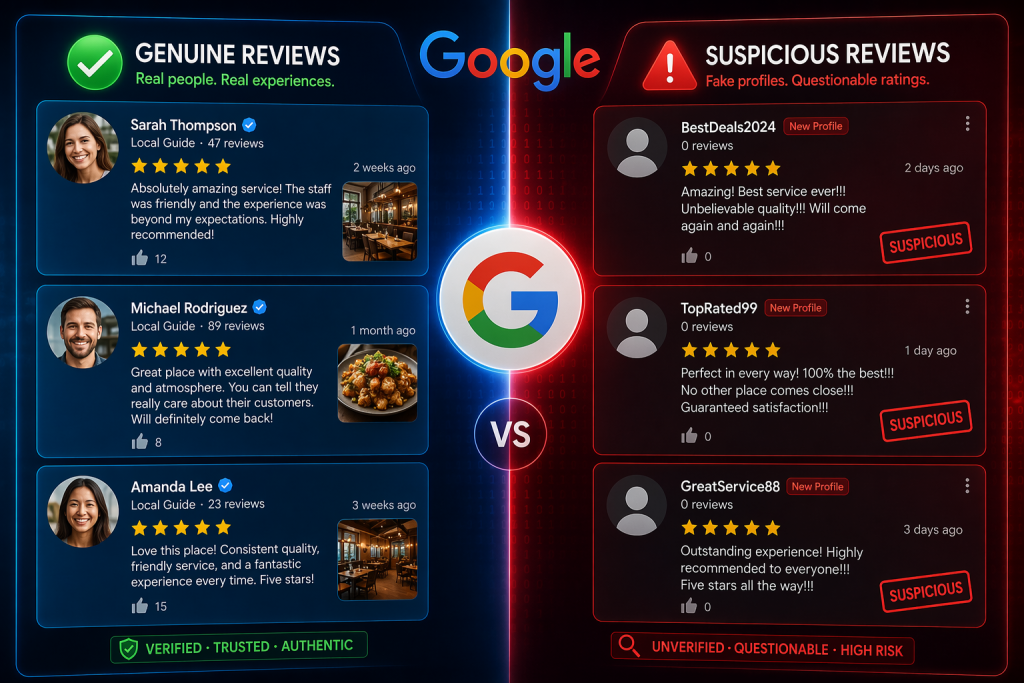
You can usually spot fake reviews by slowing down and checking the details. On any review platform, genuine reviews tend to sound specific, balanced, and tied to a real visit. Suspicious ones often feel rushed, exaggerated, or oddly empty.
The biggest warning signs appear in both fake positive reviews and fake negative reviews. A glowing review with no substance can be just as questionable as a harsh complaint with no facts. Star ratings alone do not tell the full story.
- Look for specific details such as staff names, products, services, or timelines.
- Be cautious with extreme praise or extreme criticism that feels out of proportion.
- Watch for copy-and-paste wording across several reviews.
- Check whether the review matches the star ratings believably.
If the wording is vague, repetitive, or disconnected from a real experience, it may not be trustworthy. Genuine reviews usually explain why the person felt the way they did.
How Common Are Fake Google Reviews in the US?
Fake Google reviews and fake online reviews are not rare. The compiled review statistics suggest that more than 30% of online reviews may be completely fake, and some reports estimate that up to 50% are manipulated in some way. That level of uncertainty can damage a business’s reputation and make buyers question even honest feedback.
The scale of the issue also explains why people have become more skeptical. When review patterns look unnatural, readers start to doubt the whole listing, not just one comment. That can affect trust, conversions, and how confidently people use search results to choose a business.
| Measure | What it suggests |
| Over 30% of reviews estimated fake | A large share of feedback may not reflect real experiences |
| Up to 50% estimated manipulated | Review patterns can be distorted even when comments are not fully invented |
| High customer dependence on reviews | Trust issues have a direct effect on buying choices |
| Strong focus on number of reviews | Volume can influence perceived credibility, even when quality is uneven |
How Fake Reviews Get Published on Google
Fake reviews get published because bad actors try to game the system before detection tools catch them. On a large review platform, some fake reviewers create accounts just to post one or two comments, while others post similar reviews across different businesses. This kind of review manipulation can target both ratings and visibility.
Some businesses want a quick boost on Google Business, Google Maps, or an old Google My Business listing. Others may be attacked by competitors using fake negative feedback. In both cases, the goal is to influence public perception without earning real praise or criticism.
Google uses automated systems that look at behavior, language, timing, and other signals, including patterns that may connect to the same source or ip address. Still, some fake reviews stay live until users report them or the system flags them for removal.
Common Signs of Fake Google Reviews
Most fake reviews leave clues. You may notice repetitive language, vague praise, or a suspicious review that feels disconnected from a real customer experience. When several comments on a business profile sound almost identical, such reviews are worth attention.
Another sign is imbalance. Real feedback often includes nuance, while fake reviews tend to sound too perfect or too hostile. Timing also matters. To spot trouble early, it helps to study reviewer accounts, wording, and posting patterns rather than focusing only on star counts.
Analyzing Reviewer Profiles and History
A reviewer’s profile can reveal a lot. If you are unsure about a comment, click through and see what else that person has posted. Fake reviewers often leave very few comments, or they review many unrelated businesses in ways that look unnatural.
Genuine reviews usually come from accounts with a more believable pattern. You may see varied locations, different types of businesses, and comments with real context. By contrast, empty profiles or one-time reviewers can be a red flag, especially when the wording is generic or contains similar wording.
- Check whether the reviewer’s profile has only one review.
- Look for similar reviews posted across different businesses.
- See whether the account shows normal activity over time.
This does not prove every short profile is fake, but it helps. When profile clues line up with odd review statistics on a Google Business Profile, suspicion becomes more reasonable.
Spotting Repetitive or Overly Positive Language
The language inside a review often tells the story. Genuine reviews usually sound personal and grounded. They mention what happened, who helped, or what stood out, including detailed experiences. Fake positive reviews often skip that and lean on broad claims that could apply to almost any company.
Watch for repetitive language across multiple comments. If several positive reviews use the same phrases, tone, or sentence structure, that is suspicious. The same goes for extreme language like “best” or “worst experience” with no real explanation behind it.
Another clue is how the emotion is delivered. Reviews loaded with hype, all caps, or too many exclamation points can feel manufactured. Not every excited customer is fake, of course, but genuine reviews usually balance praise with enough detail to make the experience believable.
Patterns in Timing and Bulk Review Activity
Timing can expose what the wording hides. One of the clearest warning signs is a sudden influx of reviews posted in a short timeframe, especially when the business normally gets feedback at a slower pace. That kind of spike can point to bulk review activity.
A natural review flow tends to be spread out. Real customers leave comments after visits, purchases, or service appointments, so the pattern usually feels uneven but believable. When dozens of new reviews appear almost at once, you should take a closer look at what changed.
This does not always prove review manipulation, but it is a major red flag when combined with vague language, duplicate phrasing, or weak profiles. If timing, tone, and account history all look off, there is a strong chance the reviews were not earned naturally.
Why Do Fake Google Reviews Happen?
Fake Google reviews happen because reviews influence trust, clicks, and visibility. When feedback affects buying decisions, some people try shortcuts. That can mean review manipulation to improve a business profile or to hurt a rival’s standing.
For business owners, the pressure can feel real, especially when they need more visibility or want to recover from bad ratings. But the reasons behind fake reviews are not always the same. The next sections look at motivation, competitive abuse, and how false feedback changes customer choices.
Motivations Behind Posting Fake Reviews
Some fake reviews are posted to make a business look better. If a listing has too few comments or weak ratings, review manipulation can seem like an easy fix. A few glowing posts may appear to strengthen the business profile without waiting for real customer feedback.
Other cases go the opposite way. Competitors or bad actors may leave fake negative reviews to damage trust and push customers elsewhere. These attacks can lower ratings, trigger worry, and force a business to spend time defending itself instead of serving customers.
So why do some businesses get fake Google reviews? Usually because reviews influence reputation and buying behavior. Whether the goal is self-promotion or sabotage, the common thread is the same: someone wants to shape public opinion without relying on honest experience.
How Competitive Businesses Use Fake Reviews
Competition can push some business owners toward unethical practices. Instead of improving service, they try to influence perception by planting fake reviews on their own listing or posting harmful comments on someone else’s. Because reviews affect clicks and trust, the temptation is easy to understand, even if it is wrong.
This behavior can show up on Google Maps, local listings, and other high-visibility placements. Fake reviewers may post short attacks, copied complaints, or generic praise designed to move ratings quickly, especially when they link to external websites. In some cases, the pattern is obvious right away. In others, it takes further investigation.
If a business suddenly receives suspicious feedback with no matching customer records or context, a competitor may be involved. The first step is to document the pattern, flag the reviews, and compare language, timing, and account behavior before deciding how serious the attack may be.
How Fake Reviews Can Impact Consumer Decisions
Fake reviews distort how people choose where to spend money. Potential customers often scan ratings and comments, so even a few misleading posts can push them toward or away from a business. That means false feedback can shape consumer decisions before the company gets a fair chance.
The damage is not only about sales. A business’s reputation can weaken when readers begin to doubt what they see. Even genuine praise may be questioned if the listing shows strange patterns, inflated claims, or suspicious timing. That loss of trust can be hard to repair.
Customer confidence depends on honest signals. When fake reviews crowd out real experiences, people make decisions with less clarity. Some choose poor services they should have avoided, while others skip good businesses that actually earned positive feedback from real customers.
How Fake Google Reviews Affect Businesses and Customers
Fake Google reviews create problems on both sides of the transaction. For businesses, false customer feedback can damage ratings, weaken trust, and complicate how the public perceives the brand, undermining their SEO efforts. For shoppers, it becomes harder to separate honest experiences from manipulation.
The bigger issue is confidence. When people suspect a listing contains false signals, they question the whole business’s reputation, not just one comment. That can reduce conversions, increase skepticism, and hurt fair competition. The following sections explain the effects on trust, customers, and local visibility.
The Impact on a Business’s Reputation and Trustworthiness
A business’s reputation can shift quickly when fake reviews appear. One suspicious Google review may not do much on its own, but a cluster of them can change how prospective customers interpret the listing. If the comments look false, trust drops even before customers contact the company.
Negative reviews are especially harmful when they appear to be coordinated or dishonest. They can lower ratings, create confusion, and make a business seem unreliable. At the same time, fake praise also causes damage because readers may start doubting whether the business earned any of its compliments.
That is the real cost: trustworthiness becomes uncertain. Genuine reviews lose power when false ones surround them. Once people question authenticity, they may choose a competitor, leave the page, or hesitate long enough that the business loses the opportunity.
Consequences for Genuine Customers
Genuine customers rely on authentic reviews to make smarter choices. When online reviews are manipulated, they may pick a business that did not deserve the praise or avoid one that actually provides solid service. That weakens the value of authentic feedback for everyone.
The effect shows up in customer satisfaction too. If someone chooses based on false signals and gets a disappointing experience, trust in reviews drops. Over time, people become more skeptical, even when they are reading honest comments from real buyers.
Local businesses can suffer the most from this confusion. They often depend on word of mouth and steady review growth to build credibility. When fake content distorts the picture, customers lose a dependable guide, and the businesses that truly earn strong feedback may be overlooked.
The Effect on Small Businesses and Local Search Results
Small businesses often feel review problems more sharply because they have less room to absorb damage. A few fake reviews can move the average rating faster on a smaller listing, which can affect trust and visibility almost immediately.
Search results are part of that impact. Reviews influence local seo through signals like rating quality, freshness, and review volume. If fake reviews boost a listing temporarily, the gains are unstable. If they trigger removal or policy action, the listing may lose visibility instead.
That is why sustainable seo matters. Long-term performance comes from authentic service, regular review requests, and consistent customer experience. Small businesses that focus on real feedback build stronger search presence over time than those trying to force quick gains through fake reviews.
Conclusion
In conclusion, while Google reviews can significantly influence consumer decisions and business reputations, the prevalence of fake reviews raises important questions. Understanding how to identify genuine feedback, including honest negative feedback, from fraudulent entries is essential for both consumers and businesses alike. By recognizing common signs of fake reviews, such as repetitive language or suspicious patterns in review timing, you can better navigate the landscape of online feedback. Moreover, acknowledging the motivations behind fake reviews can empower consumers to make informed choices and help businesses maintain their trustworthiness. Remember, a vigilant approach to evaluating reviews ensures that you’re making decisions based on authentic experiences. If you want to learn more about maintaining your business’s reputation, don’t hesitate to get in touch for a free consultation!
Frequently Asked Questions
Can I report a fake Google review, and how does the process work?
Yes. You can report fake Google reviews and bad reviews through your business profile by flagging the suspicious post and selecting the violation type. Google reviews it against Google’s policies and may remove it. In serious cases involving repeated abuse, businesses may also consider documenting evidence in case legal action becomes necessary.
Are Google reviews trustworthy when choosing a service or product?
A Google review can be helpful, but you should read more than one. Genuine reviews usually include specifics and feel balanced. Potential customers should compare several online reviews, check the average rating, and look for patterns rather than relying on one very positive or very negative comment.
Does Google do enough to prevent and remove fake reviews?
Google does take fake reviews seriously and uses automated systems to detect suspicious review patterns on a regular basis. It also allows users to flag posts for further investigation. Still, some false content gets through, so removal depends on both enforcement tools and user reporting.